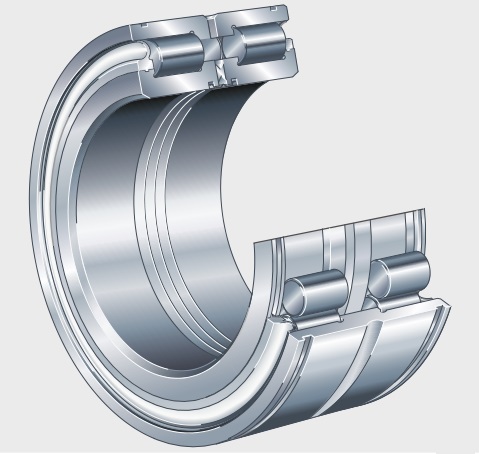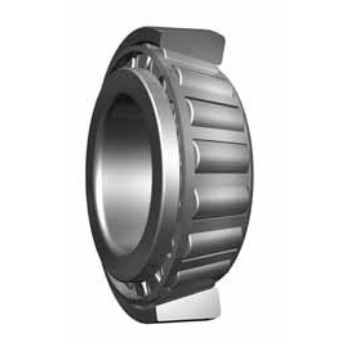


SL045008 Bore 40 Mm, Cylindrical Roller Bearings With Snap Ring Grooves Full Complement



The SL045008 Full complement cylindrical roller bearings are widely used in low-speed, heavy-load applications with high impact loads, such as: construction machinery (cranes, excavators), rolling mills (roll supports), mining machinery (crushers), wind power generation (main shafts), marine propulsion systems, and heavy-duty gearboxes.
The SL045008 bearing is a Cylindrical roller bearings with snap ring grooves Full complement with an inner diameter of 40 mm , an outer diameter of 68 mm, a width of 38 mm. It typically uses PN grade precision tolerances and GCr15 / 100Cr6 rings, GCr15 / 100Cr6 rolling mlement. Its dynamic radial rated load is approximately 79252 N, its static radial rated load is approximately 110797 N. It uses CN standard radial clearance, together determine its load-bearing capacity, rotational accuracy, and applicable working conditions.
SL045008 bearings ( 40 mm x 68 mm x 38 mm) have the advantages of The cageless design maximizes the number of rollers, resulting in extremely high radial load capacity and impact resistance, and are therefore widely used in the Rolling mills, hoisting machinery, large gearboxes, injection molding machines and mining equipment.
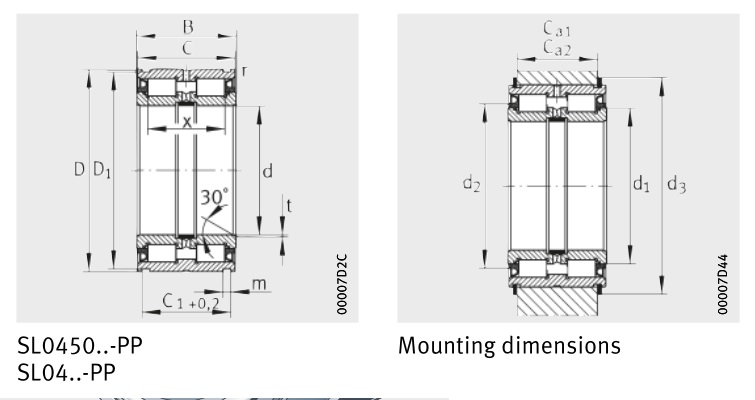
| Part Number | SL045008 |
| Type | SL04 |
| Bearing Type | Cylindrical roller bearings with snap ring grooves Full complement (locating bearing) |
| Manufacturer Part Code | SL045008 |
| Equivalent | SL04 5008 |
| Series | SL0450 |
| Tolerance class | PN |
| Radial internal clearance | CN |
| Ring | outer ring(central), inner ring(3) |
| Chamfer angle | 30 |
| Weight [lb] | 1.138 |
| d φ Inside [inch] | 1.575 |
| D Φ Outside [inch] | 2.677 |
| B Width [inch] | 1.496 |
| C Width [inch] | 1.457 |
| C1 (+0.2) [inch] | 1.268 |
| D1 [inch] | 2.591 |
| m [inch] | 0.106 |
| r(min.) [inch] | 0.024 |
| t [inch] | 0.031 |
| X [inch] | 1.122 |
| Cr Radial Dynamic [lbf] | 17815 |
| C0r Radial static [lbf] | 24907 |
| Cur Radial Fatigue [lbf] | 3642 |
| nb Limiting speed (grease) [rpm] | 3105 |
| Mounting dimensions | |
| d1 [inch] | 2.028 |
| d2 [inch] | 2.165 |
| d3 [inch] | 2.953 |
| d1 (min) [inch] | 2.028 |
| Ca1(–0.2) [inch] | 1.102 |
| Ca2(–0.2) [inch] | 1.063 |
The SL045008 Full complement cylindrical roller bearings mainly consist of an inner ring, an outer ring, cylindrical rollers, and a sealing device, without a cage. The rollers and raceways are fully fitted, maximizing the number of rollers. They typically employ a NU or N-type design, allowing for axial displacement compensation.
Full complement cylindrical roller bearings have extremely high radial load capacity. Due to the large number of rollers and the absence of a cage, their load capacity is more than 30% higher than that of caged bearings of the same size. They have a compact structure, making them suitable for heavy-duty applications in confined spaces. They also offer excellent shock resistance, making them suitable for withstanding vibrations and transient overloads.
Share this product to:


 Let more people see your product