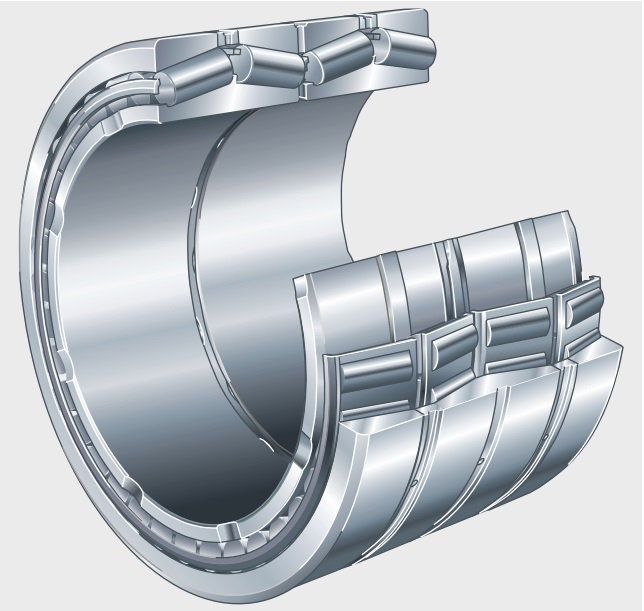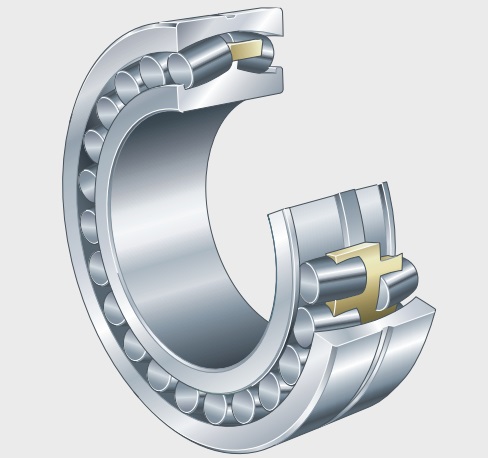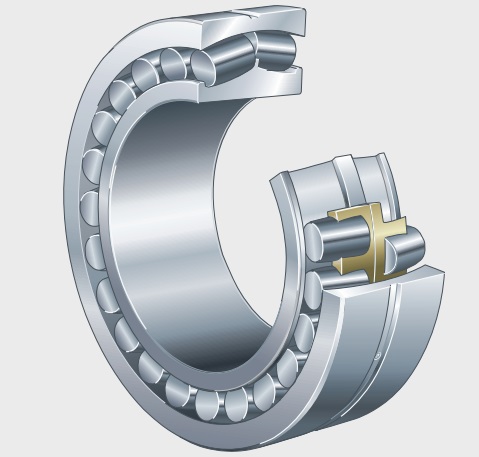


F-802405.TR4-D1 Tapered Roller Bearings, Four-row, Stamping Steel Cage



The F-802405.TR4-D1 Four-row tapered roller bearings are suitable for applications involving heavy combined loads. Classic applications include rolling mill work rolls, heavy machine tool spindles, mining crushers, oil drilling rig turntables, large wind turbine spindles, and shaft positioning ends of ship propulsion systems.
The F-802405.TR4-D1 bearing is a Tapered roller bearings, four-row with an inner diameter of 635 mm , an outer diameter of 482.6 mm, a width of 421 mm. It typically uses ABMA4A (Class 4) grade precision tolerances and GCr15 / AISI 52100 rings, 20Cr2Ni4A rolling mlement. Its dynamic radial rated load is approximately 7999778 N, its static radial rated load is approximately 18998958 N. open type, together determine its load-bearing capacity, rotational accuracy, and applicable working conditions.
F-802405.TR4-D1 bearings ( 635 mm x 482.6 mm x 421 mm) have the advantages of It can withstand extremely high radial loads and bidirectional axial loads, has a compact structure, and is highly rigid, making it suitable for heavy-duty impact conditions, and are therefore widely used in the Metallurgical rolling mills, large gearboxes, heavy mining machinery, oil drilling equipment.
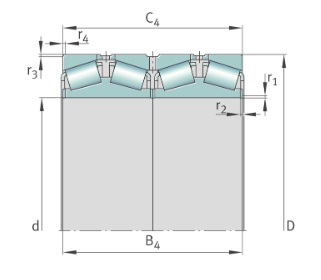
| Part Number | F-802405.TR4-D1 |
| Bearing Type | Tapered roller bearings, four-row |
| Seal type | open |
| Cage | Stamping steel, roller-guided |
| bearing Series | F series (F-8024..TR4-D1) |
| Accuracy class | ABMA4A (Class 4) |
| Rows Nomber | Four |
| Matched arrangement | TQO = TQO arrangement |
| Units | Metric |
| Manufacturer Part Code | F-802405.TR4-D1 |
| Temperature - T(min) | -30 °C |
| Temperature - T(max) | 120 °C |
| Heat treatment | Case hardened |
| Bore design | Z = cylindrical bore |
| Axial internal clearance | A300-400 = Between 300 μm and 400 μm |
| Weight [kg] | 355 |
| d φ Inside [inch] | 19.000 |
| D Φ Outside [inch] | 25.000 |
| B4 Inside Width [inch] | 16.575 |
| C4 Outside Width [inch] | 16.575 |
| Cr Radial Dynamic [lbf] | 1798350 |
| C0r Radial Static [lbf] | 4270965 |
| Cur Radial Fatigue [lbf] | 386493 |
| r1, r2(min.) Chamfer [mm] | 3 |
| r3, r4(min.) Chamfer [mm] | 6.4 |
| e Calculation coefficient | 0.33 |
| Y1 Calculation coefficient | 2.03 |
| Y2 Calculation coefficient | 3.02 |
| Y0 Calculation coefficient | 1.98 |
The F-802405.TR4-D1 Four-row tapered roller bearings typically consist of two double-raceway outer rings, two single-raceway inner rings, four rows of tapered rollers, a cage, and a spacer. The inner and outer rings and rollers are designed in metric or imperial units. The axial clearance or preload can be precisely adjusted by grinding the spacer.
The advantage of four-row tapered roller bearings is that they can withstand huge radial loads and bidirectional axial loads at the same time. They have extremely high overall rigidity and excellent load-bearing capacity, making them suitable for use as fixed ends to achieve precise axial positioning. However, their limiting speed is relatively lower than that of cylindrical roller bearings.
Share this product to:


 Let more people see your product