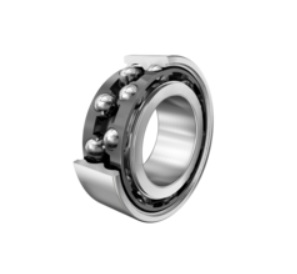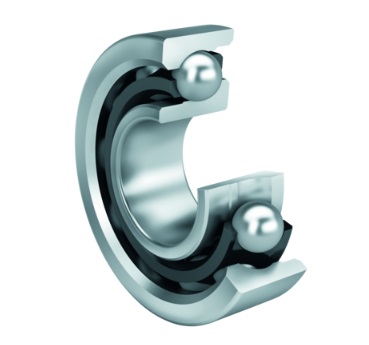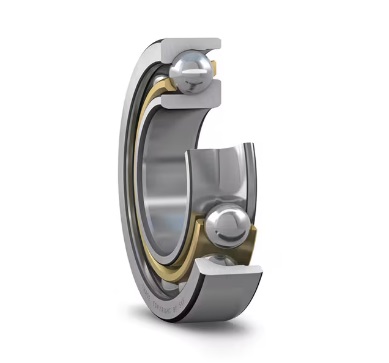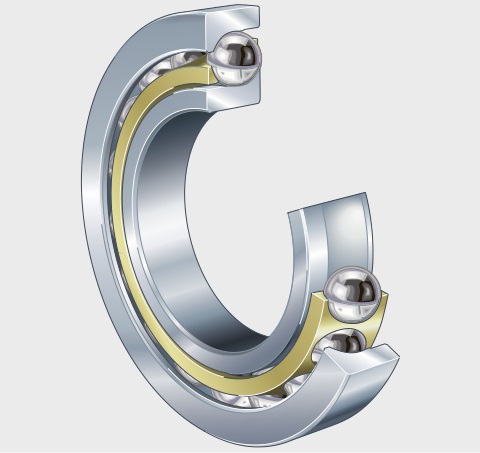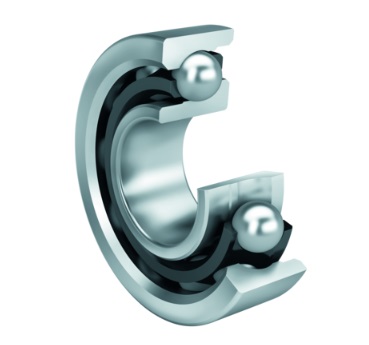


718/710 AMB Bore 710 Mm, Ball Bearing, Angular Contact, Solid Brass Cage
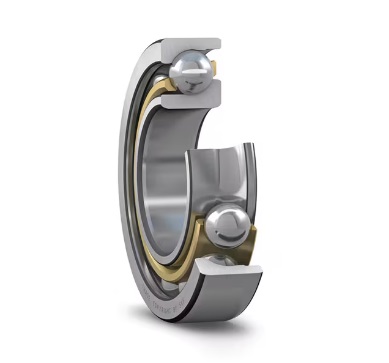


The 718/710 AMB Single-row angular contact ball bearings are widely used in precision spindles and transmission systems of heavy equipment, such as: large machine tool spindles (machining centers, grinding machines), industrial robot joints, centrifuges, compressors, large pumps, and wind power generation equipment spindles.
The 718/710 AMB bearing is a Single row angular contact ball bearings with an inner diameter of 710 mm , an outer diameter of 870 mm, a width of 74 mm. It typically uses Normal grade precision tolerances and GCr15SiMn rings, GCr15SiMn rolling mlement. It primarily bears Angular Contact, Its dynamic radial rated load is approximately 571848 N, its static radial rated load is approximately 1559828 N. Open type, together determine its load-bearing capacity, rotational accuracy, and applicable working conditions.
Interchange code: 718/710AMB
718/710 AMB bearings ( 710 mm x 870 mm x 74 mm) have the advantages of High load-bearing capacity, high rigidity, and long service life, and are therefore widely used in the Construction machinery, wind power generation, port machinery, solar tracking systems, industrial robots, medical equipment, aerospace, and military equipment.
| Part Number | 718/710 AMB |
| Internal design | A = Single row bearing with a 30 ° contact angle |
| Cage | Solid brass |
| Series | 718 A (718..AMB) |
| Contact type | 2-point contact |
| Ring type | inner ring(1), outer rings(1) |
| Lubricant | Without |
| Accuracy class | Normal |
| Manufacturer Part Code | 718/710AMB |
| Seal type | Open |
| Units | Metric |
| Rows NO. | One |
| Bearing Mass - m [lb] | 206.130 |
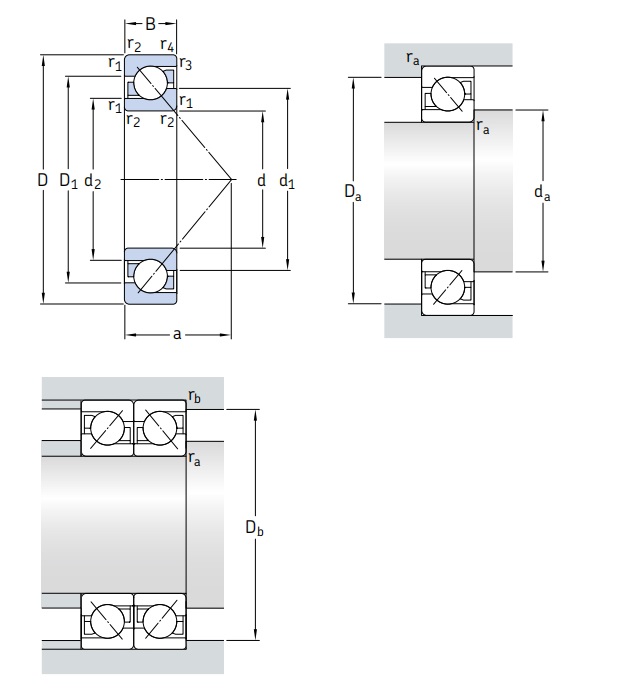
| Main Dimensions | |
| Inside - d φ [inch] | 27.953 |
| Outside - D Φ [inch] | 34.252 |
| Width - B [inch] | 2.913 |
| d1 [inch] | 30.071 |
| D1 [inch] | 32.268 |
| Contact angle - α [°] | 30 |
| r1, r2(min.) [inch] | 0.157 |
| r3, r4(min.) [inch] | 0.059 |
| a [inch] | 10.433 |
| Performance | |
| Dynamic Radial - Cr [lbf] | 128551 |
| Static Radial - C0r [lbf] | 350649 |
| Fatigue load limit - Pu [lbf] | 5288 |
| Speed ratings (grease) - nB [r/min] | 628 |
| Speed ratings (oil) - nG [r/min] | 660 |
| Mounting dimensions | |
| ra(max.) [inch] | 0.118 |
| rb(max.) [inch] | 0.059 |
| Db(max.) [inch] | 33.976 |
| da(min.) [inch] | 28.543 |
| Da(max.) [inch] | 33.661 |
| Coefficient | |
| Kr | 0.08 |
| (<>, ><) - Y2 | 1.24 |
| (single, tandem) - Y2 | 0.76 |
| (<>, ><) - Y1 | 0.78 |
| (<>, ><) - Y0 | 0.66 |
| (single, tandem) - Y0 | 0.33 |
| (<>, ><) - X | 0.63 |
| (single, tandem) - X | 0.39 |
| Limiting value - e | 0.8 |
| A | 17 |
The 718/710 AMB Single-row angular contact ball bearings mainly consist of an inner ring, an outer ring, steel balls, and a cage. The raceways of the inner and outer rings are offset from each other, forming a contact angle. They are typically designed as non-separable bearings with contact angles of 15°, 25°, or 40°. The cage can be made of solid brass or phenolic resin.
The larger the contact angle of a single-row angular contact ball bearing (e.g., 40°), the stronger its axial load capacity. 15° or 25° contact angles are suitable for high-speed applications. They can simultaneously withstand radial loads and unidirectional axial loads. When installed in pairs (back-to-back, face-to-face, or in series), they can withstand bidirectional axial loads and improve rigidity. Larger bearings have higher basic dynamic load ratings, reaching hundreds of kN or more.
Share this product to:


 Let more people see your product